














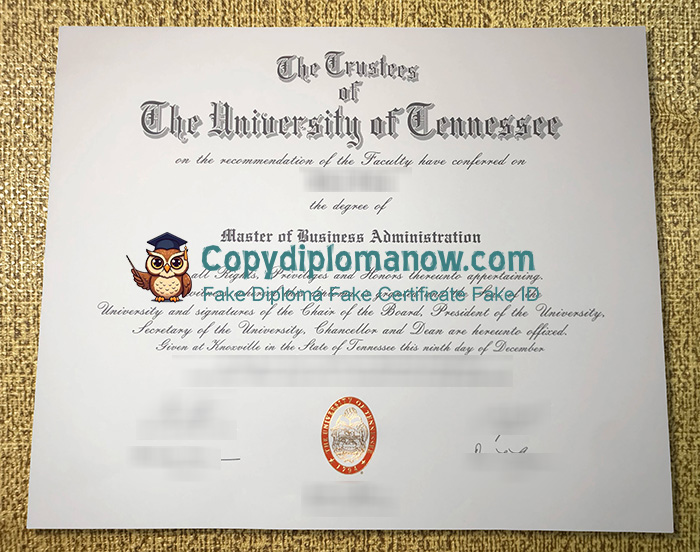
The Easy Way to Get University of Tennessee Diploma, The University of Tennessee, Knoxville Diploma, Founded as Blount College in 1794, and acquiring its current moniker in 1879, the University of Tennessee Knoxville is one of the oldest universities in the US and is the largest in the state of Tennessee.
Today, the institution, based in the southern US city of Knoxville, employs more than 9,800 faculty and staff in its 11 colleges, and offers more than 300 degree programmes.
While the University of Tennessee Knoxville does have an international student cohort, hailing from more than 90 countries, the majority of its undergraduates are from the US southern states of Tennessee, Georgia, North Carolina and Virginia.
Many of its 25,000 graduates and undergraduates are attracted to the university by its lush campus – it has more than 230 buildings set in 560 acres – as well as its close proximity to the Great Smoky Mountains National Park, which is about a 45-minute drive away.
The university is also a major research hub, overseeing (in partnership with the Battelle Memorial Institute) one of the biggest government laboratories in the US, the Oak Ridge National Laboratory. The ORNL’s scientific programmes focus on energy, systems biology, materials, neutron science and national security. The laboratory also houses one of the world’s most powerful supercomputers. Get Fashion Institute of Design and Merchandising Diploma.
Is an Advanced Degree Worth the Work Required?
It’s important to ask yourself: Is it worth it to pursue a master’s degree? In addition to job security, master’s degrees offer other benefits. You become more qualified for certain kinds of jobs, increasing your job security, especially during recessions. A Master’s degree can also get you a better salary than a Bachelor’s degree alone.
Earning a master’s degree is a major investment in your future. It requires significant amounts of work and research, and most universities require that applicants hold a master’s degree before applying for a PhD. However, if you’re not planning on pursuing a PhD, it might not be worth the effort. And if you’re not sure if you’re up for it, consider what barriers may be present in your chosen field.
After you’ve decided that a master’s degree is right for you, identify a career that you’d like to pursue. You can ask current workers what master’s degree programs they’ve taken. If you’re unsure, you can use your network to find opportunities. You can also contact the alumni career center of your undergraduate school. In some professions, there are workers who are willing to mentor others.
Despite its benefits, a master’s degree can be expensive. The median net tuition for master’s programs costs $11,000. Depending on the field of study, some can cost as much as $29,000. Public universities typically have net tuition prices based on prices for state residents. While these figures include the cost of tuition and other required fees, they do not include living expenses.