













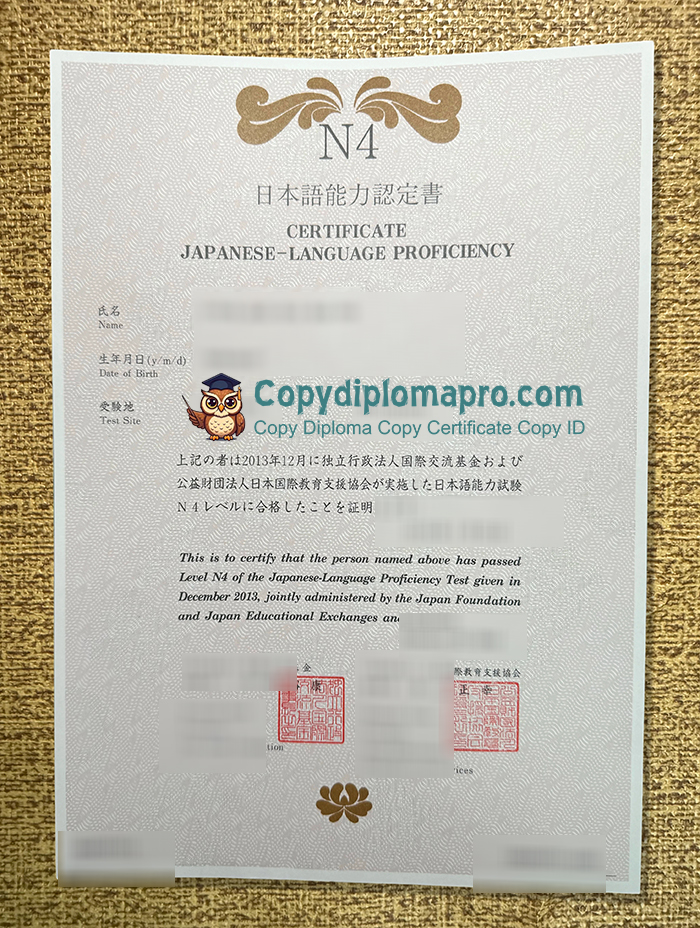
How to use a phony JLPT N4 Certificate, Japanese-Language Proficiency Test Certificate, The Japanese-Language Proficiency Test (JLPT) is the most widely recognized standardized examination for measuring the Japanese-language ability of non-native Japanese speakers. It is administered by the Japan Foundation and Japan Educational Exchanges and Services (JEES) and is commonly used by students, professionals, employers, and educational institutions to evaluate Japanese-language proficiency.
The JLPT has five levels, ranging from N5, the most basic level, to N1, the most advanced. The examination evaluates Japanese knowledge and practical comprehension through areas such as vocabulary, grammar, reading, and listening. Get Japanese-Language Proficiency Test Transcript.
JLPT Levels
- N5: Basic Japanese. Candidates can understand some simple Japanese expressions and sentences.
- N4: Elementary Japanese. Candidates can understand basic Japanese used in familiar daily situations.
- N3: Intermediate Japanese. Candidates can understand Japanese used in everyday situations to a reasonable degree.
- N2: Upper-intermediate Japanese. Candidates can understand a wide range of written and spoken Japanese encountered in everyday and professional contexts.
- N1: Advanced Japanese. Candidates are expected to understand sophisticated Japanese used in complex written and spoken situations.

Why Is the JLPT Important?
A JLPT certificate can be useful for university applications, employment, immigration-related procedures, scholarships, and professional development, depending on the requirements of the institution or organization involved. In particular, N2 and N1 are frequently regarded as strong indicators of advanced Japanese proficiency.
The test is also useful for learners who want an objective benchmark for tracking their progress. Because the JLPT uses standardized levels, students can clearly identify their current ability and establish goals for further study.